
Every Conversation Is a Complex Soundscape.
THE SCIENCE OF BETTER HEARING
Conversation rarely happens in silence. Whether you’re in a restaurant, walking through a busy street or engaged with people, speech is accompanied by countless other sounds arriving at your ears at exactly the same moment.
For the listening brain, the challenge isn’t simply hearing sound.
It’s identifying which sounds matter most.
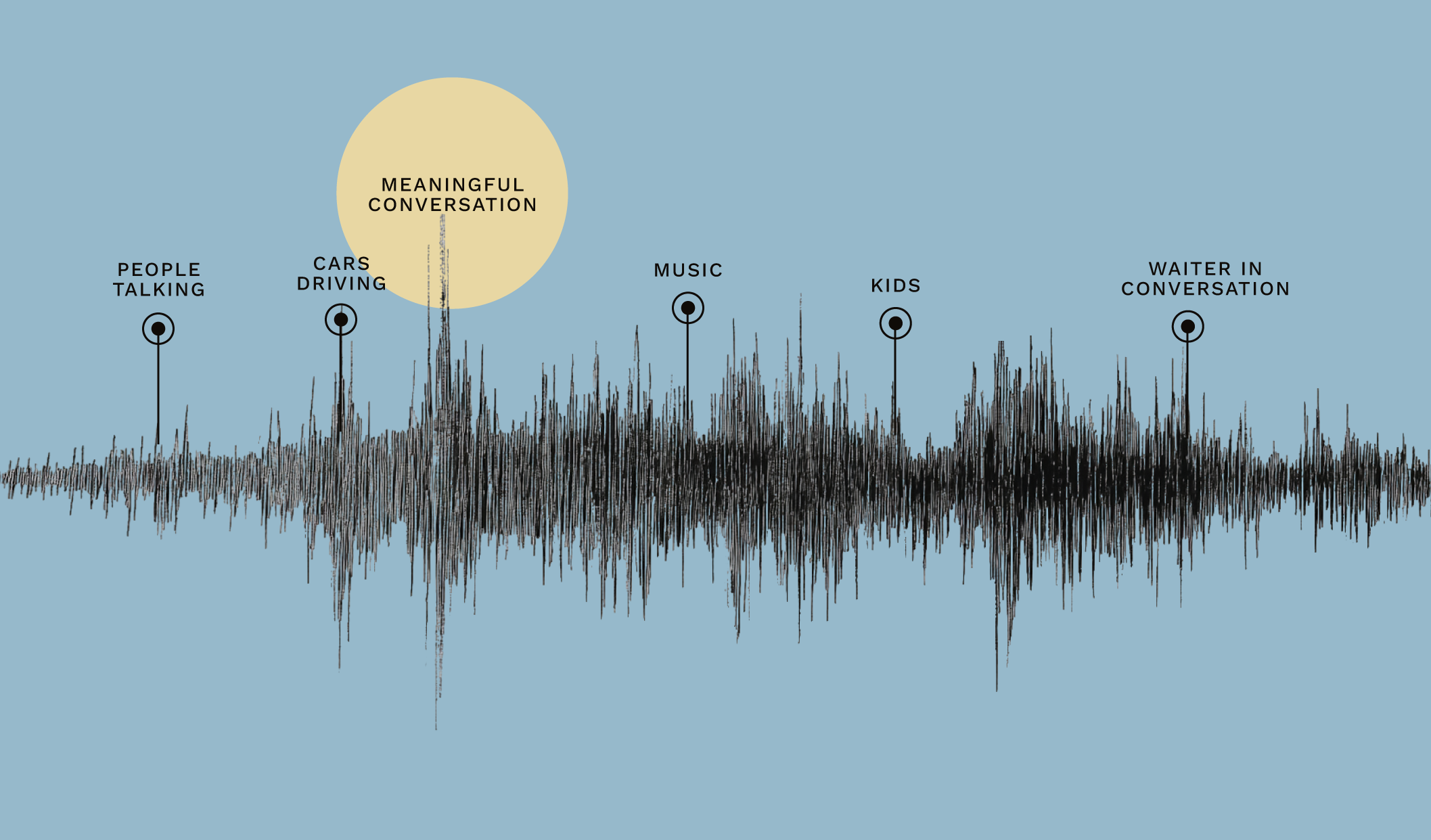
Increasingly, hearing scientists are focusing on how technology can support this process of speech separation, helping distinguish meaningful conversation from the rich acoustic environment that surrounds us.
Recent advances in deep neural networks have accelerated this research. Unlike conventional signal processing, deep neural networks are trained using millions of sound samples, enabling them to recognise complex patterns within real-world listening environments and improve the distinction between speech and background sound.
This scientific approach underpins Phonak Audéo Sphere Infinio™, which combines directional microphones with a dedicated deep neural network designed to separate speech from surrounding noise in real time. The network was trained on approximately 22 million sound samples using 4.5 million parameters.
Researchers have also begun exploring these technologies using functional near-infrared spectroscopy (fNIRS), a non-invasive neuroimaging technique that measures changes in brain oxygenation associated with listening.
In a Sonova-funded study involving experienced hearing aid users, the deep neural network programme was associated with higher listening accuracy, lower self-reported listening effort and reduced activation in the left prefrontal cortex compared with a standard programme.
These findings suggest that advanced speech-separation technology may reduce the brain resources required during demanding listening tasks, although further research will continue to refine our understanding.
For us, this represents another important shift in hearing science.
The future of hearing technology isn’t simply about processing sound.
It’s about helping the brain to organise the voices that matter most.
