
Your Ears Detect Sound. Your Brain Decides What Matters.
THE SCIENCE OF BETTER HEARING
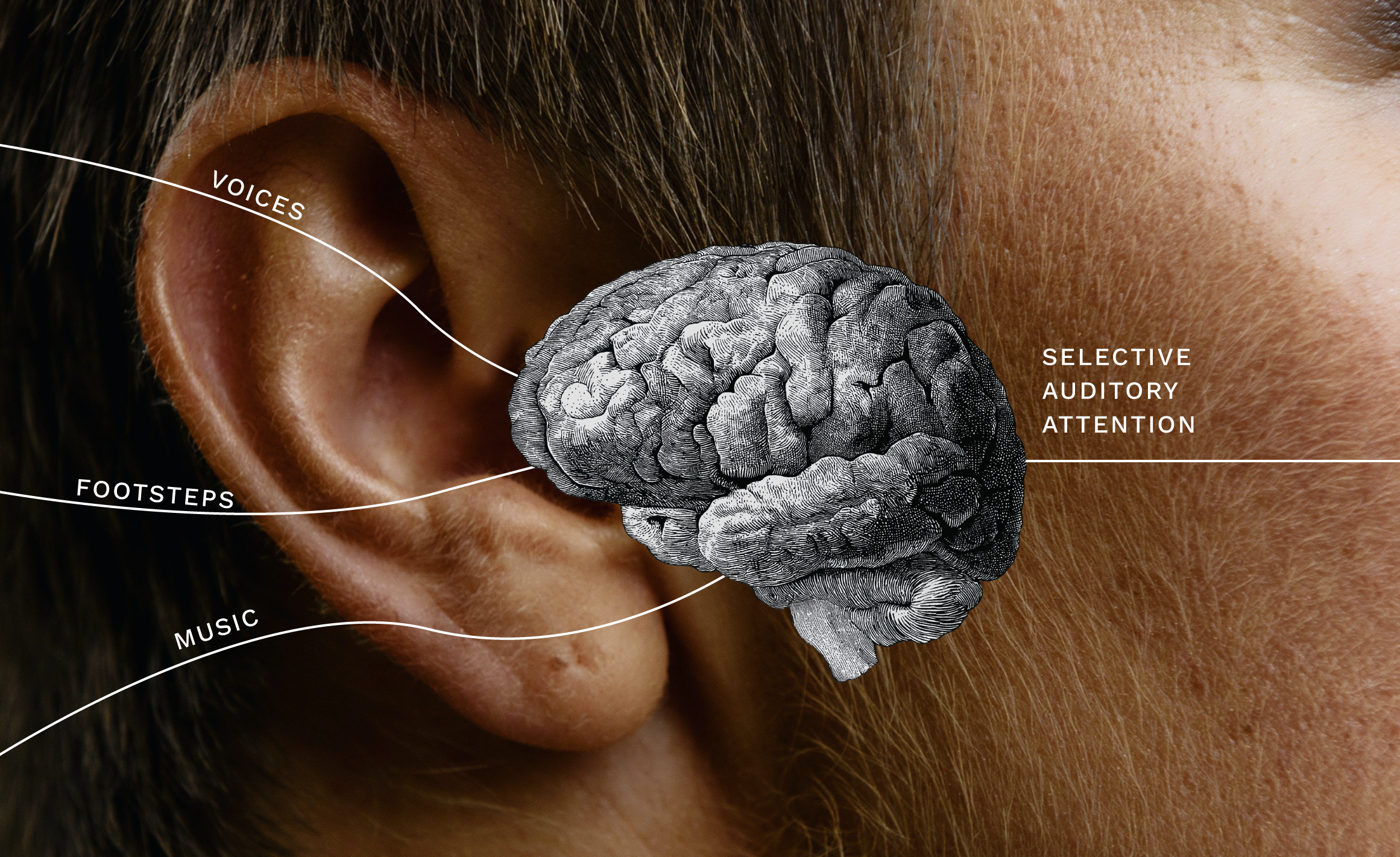
For decades, hearing science focused primarily on the ear.
Today, researchers are increasingly turning their attention to something equally important: the listening brain.
Every second, your auditory system receives an extraordinary amount of information. Voices, footsteps, music, traffic, ventilation systems and countless other sounds arrive simultaneously.
Yet conversation rarely feels like one continuous stream of noise.
Instead, the brain continually organises this complex soundscape, deciding what deserves our attention and what can remain in the background.
This process, known as selective auditory attention, has become one of the most important areas of modern hearing research.
Recent studies from Eriksholm Research have explored how hearing technology can influence the brain’s representation of the person we choose to listen to, while reducing competing background sound. Rather than simply processing sound, researchers are now investigating how technology can better support the brain’s natural listening processes.
This scientific understanding forms the foundation of Oticon’s BrainHearing™ philosophy.
Oticon Intent™ builds on this by incorporating information about head movement, body movement, the acoustic environment and conversational activity to estimate what the wearer may be trying to hear.
For us, this represents something much bigger than a new hearing aid.
It reflects a broader shift in hearing science.
Increasingly, researchers are moving beyond how we hear sound towards understanding how we listen.
Because hearing isn’t simply about detecting sound - it’s about making sense of the world around us.
Let’s explore what this could mean for you.
