
AI Is Teaching Hearing Science to Think Differently
THE SCIENCE OF BETTER HEARING
Artificial intelligence is often discussed as a feature of the latest hearing technology - there’s been a lot of talk about this recently.
But its more important role begins much earlier, in the hearing science research itself.
AI is allowing hearing scientists to analyse extraordinarily complex information: millions of sound samples, patterns of head and eye movement, physiological responses, brain activity and data gathered from listening experiences in the real world.
Questions that once had to be studied separately can increasingly be considered together.
What is happening in the soundscape? Where is the listener directing their attention? How much effort is the brain using? Which sounds are meaningful, and which are distracting? How do the answers change from one person, place and moment to another?
At Eriksholm Research Centre in Denmark, scientists are using machine learning alongside EEG, eye tracking, motion tracking and real-world data to investigate auditory attention and listening intention.
The long-term ambition is significant: technology that does not simply analyse surrounding sound, but becomes better able to recognise what the listener is trying to hear.
Researchers are also investigating how AI might personalise hearing rehabilitation itself. Information gathered through hearing devices, wearable technology and real-life listening reports are helping us understand where someone is struggling outside the clinic and refine their care accordingly.
This is one of the ways AI is fast-tracking innovation. It can recognise patterns across volumes of information that no research team could manually process at the same speed.
It can also learn from enormous libraries of sound.
Instead of relying only on fixed rules about “speech” and “noise”, deep neural networks can be trained on millions of acoustic examples. They learn to distinguish between voices, traffic, music, movement and competing conversation with increasing sophistication.
We are moving from technology that follows predetermined instructions to technology that has learned how complex sound behaves.
FROM RESEARCH TO REAL-TIME HEARING
This scientific thinking is now being interpreted in different ways by the world’s leading hearing-technology manufacturers.Each is addressing a slightly different question.
PHONAK
HOW CAN AI SEPARATE SPEECH FROM ‘NOISE’?
Phonak’s Infinio platform is built around its ultra-responsive ERA chip, which supports rapid sound processing, adaptive performance and connectivity.
In Phonak Audéo Sphere Infinio, ERA works alongside a second, dedicated AI processor called DEEPSONIC™. Its deep neural network has been trained using more than 22 million sound samples and analyses complex listening environments in real time.
The purpose is highly specific: to identify speech within a dense sound scene, separate it from competing noise and provide the brain with a cleaner signal to interpret, even when a voice is not directly in front of the listener.
OTICON
HOW CAN AI SUPPORT THE LISTENING BRAIN?
Oticon Reveal™ begins with another scientific insight: the brain needs more than an isolated speech signal.
It also uses meaningful contextual sound to understand where it is, what is happening and where attention may need to shift next.
There’s important contextual sounds that are crucial to hear.
In a difficult listening situation, research found that Reveal delivered 60% stronger stimulation of the brain than Oticon’s previous generation of premium hearing technology.
When listeners heard a relevant contextual sound, the brain prioritised it almost three times more strongly than other contextual sounds.
The aim is not to remove the sound world around the listener. It is to provide the brain with speech and vital contextual information, so that it can decide where to focus attention.
WIDEX
CAN AI IMPROVE CLARITY WITHOUT LOSING NATURAL SOUND?
Widex Allure AI RIC addresses a third question: how can AI provide additional speech support in noise without sacrificing the natural quality of the wider sound environment?
Its Clarity Boost programme has a dedicated AI co-processor and a third-generation, audio-specific deep neural network.
Rather than trying to remove every surrounding sound, it partially reduces noise while preserving speech, environmental awareness and the natural sound quality that's always been core to the Widex approach.
This sits alongside PureSound™ and ZeroDelay™ processing, developed to minimise processing delay and preserve the subtle acoustic cues that help sound to feel natural.
In an initial study, Clarity Boost improved word recognition by 20.5% compared with Widex Allure’s Universal programme when speech came from the sides. Participants in the study also reported lower listening effort and more comfort.
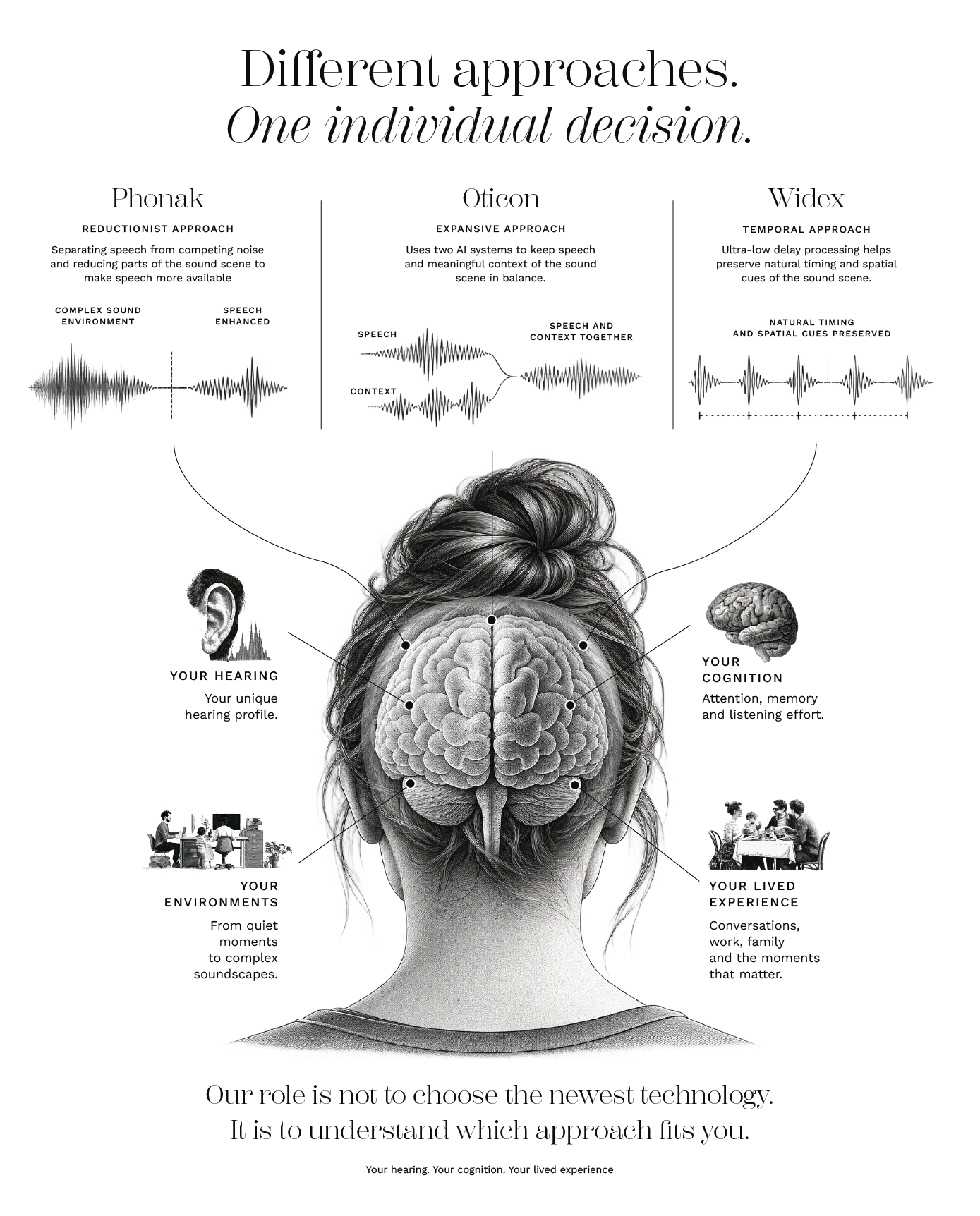
Different approaches. One individual decision.
What interests us is not simply that manufacturers are using AI. It is how they are using it, which scientific questions they are attempting to answer and where the resulting technology could offer a real clinical benefit.
Phonak is applying AI to the separation of speech from noise.
Oticon is using Dual AI to balance speech with meaningful contextual sound.
Widex is combining AI-based speech support with its focus on natural sound.
None of these approaches can be considered in isolation from the person who will use the technology.
Different technologies, different approaches to sound, for different people.
The important thing is not which technology is newest, but which approach is most appropriate for you: for your hearing, your cognition and the way your brain processes the sound scene. Some people may benefit from a fuller, more context-rich acoustic picture. Others might require a more reductionist approach. The latter group could respond better to greater separation of speech from competing noise, to reduce listening effort and support conversation. The ‘best tech solution’ depends entirely on the individual.
Which approach is right for your hearing and brain?
As an independent audiology practice, we're never limited to one manufacturer or one philosophy of sound processing.
We follow the science intently, carefully consider the innovations and understand how different approaches relate to every individual’s specific hearing ability, auditory processing, listening environments and lived experience.
We know that the most technologically advanced hearing aid is not automatically the right one for every person.
The right technology is the one that provides a measurable, meaningful benefit in the situations that matter to you. This is a fascinating discussion and we'd welcome the opportunity to have it with you.
EXPLORE WHICH APPROACH IS RIGHT FOR YOUR HEARING AND BRAIN
